





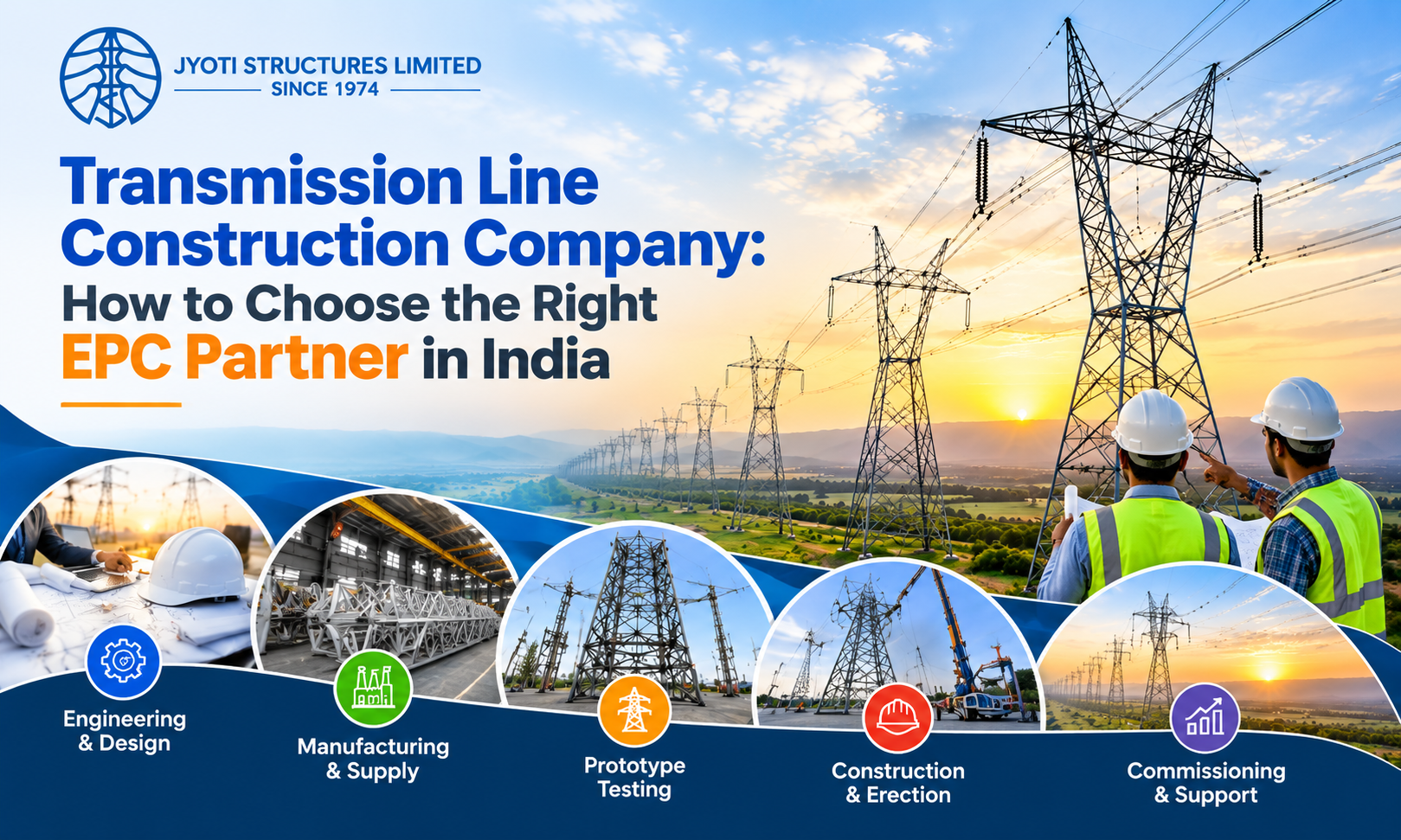
Transmission Line Construction Company: India’s growing electricity demand, renewable energy projects and expanding industrial infrastructure have increased the need for reliable power networks. Building these networks requires more than materials and manpower. It demands careful engineering, dependable supply chains, strict quality control and experienced project execution.
Choosing the right Transmission Line Construction partner is therefore an important decision for power utilities, infrastructure developers and project owners. A capable Engineering, Procurement and Construction (EPC) company can coordinate multiple project stages, manage technical challenges and help deliver infrastructure that meets the required specifications.
1. Evaluate Technical Expertise and Project Experience
Before selecting an EPC contractor, review its experience with projects of comparable voltage levels, route lengths and site conditions. Construction across deserts, hilly regions, river crossings and densely populated areas can present very different engineering and logistical challenges.
Check the company’s completed projects, technical capabilities and experience with high-voltage and extra-high-voltage infrastructure. A proven project portfolio offers a more meaningful basis for evaluation than marketing claims alone.
2. Check In-House Engineering and Manufacturing Capabilities
An integrated EPC partner can coordinate engineering, material procurement, fabrication, testing, site construction and commissioning more effectively. In-house capabilities may also help improve communication between technical teams and reduce avoidable coordination gaps.
When evaluating a Transmission Line Tower Manufacturer, examine its design expertise, production infrastructure, quality-control procedures and ability to meet project specifications. Ask whether prototype assembly and structural validation form part of its manufacturing process.
Jyoti Structures Limited provides design and engineering, manufacturing, testing, construction and commissioning services for power infrastructure projects. Its manufacturing facilities in Nashik and Raipur have a combined annual production capacity exceeding 100,000 metric tonnes. <Cite refs={[“turn784404search0″,”turn784404search2”]}/>
3. Prioritise Quality Assurance and Safety
The reliability of a power network depends on the quality of its structures, components and installation. Inadequate inspection or deviations from approved specifications can create operational risks and expensive corrective work.
Before finalising a contractor, review its quality assurance systems, inspection procedures, certifications, testing facilities and site safety practices. Confirm how non-conformities are documented and resolved, and whether material traceability is maintained throughout the project.
For projects involving Transmission Line Towers, prototype validation and appropriate structural testing are particularly important. These checks help verify that the design and components meet the applicable technical requirements before large-scale deployment.
4. Assess Procurement and Supply Chain Reliability
Project schedules can be affected by material shortages, delayed deliveries and limited production capacity. A reliable supplier should have established procurement processes, suitable manufacturing resources and realistic delivery commitments.
Ask prospective partners about their raw-material sourcing, production planning, inventory management and logistics arrangements. Also clarify how they handle design changes, urgent requirements and supply disruptions.
An EPC company with coordinated procurement and manufacturing operations can offer better visibility across the project lifecycle. However, buyers should still verify capacity, delivery schedules and contractual commitments for the specific assignment.
5. Understand the Full Scope of EPC Services
Not every contractor offers the same scope of work. Some focus on supplying equipment, while others manage multiple stages of project execution.
Depending on the contract, services may include route surveys, design and engineering, right-of-way coordination, access roads, foundation construction, structure erection, conductor stringing, testing and commissioning. Confirm responsibilities, exclusions, timelines and acceptance criteria before signing the agreement.
Jyoti Structures Limited undertakes end-to-end power line execution, with capabilities covering projects from 66 kV to 800 kV. Its construction services include foundations, erection, stringing and commissioning.
6. Review Project Delivery and Commercial Transparency
The lowest quotation does not always represent the best value. Compare bids on technical compliance, scope coverage, delivery schedules, payment milestones, warranty provisions and post-completion support.
A professional contractor should communicate risks early, provide clear progress updates and maintain documented processes for variations and approvals. Review the project team’s experience and the company’s approach to managing site constraints before making a final decision.
Why Consider Jyoti Structures Limited?
Jyoti Structures Limited has experience in power transmission infrastructure across India and international markets. Its capabilities span engineering, manufacturing, structural testing, construction and substation-related solutions.
The company’s published project portfolio includes high-voltage assignments such as the 765 kV Khavda–Bhuj transmission line in Gujarat. Such project references give prospective clients a starting point for assessing technical experience and execution capabilities against their own requirements.
Conclusion
Selecting the right EPC partner requires a balanced assessment of technical expertise, manufacturing capacity, quality systems, procurement reliability, safety and project delivery. Thorough due diligence helps project owners identify a partner suited to their engineering requirements, budget and schedule.
For organisations planning new power infrastructure, Jyoti Structures Limited is an option to evaluate based on its integrated capabilities and documented project experience. Reviewing its services and discussing project-specific requirements can help determine whether its capabilities align with the intended scope.


