
Medical writing plays an important role in healthcare by transforming complex scientific information into clear, accurate, and useful content. From clinical research reports to patient education materials, it helps researchers, healthcare professionals, pharmaceutical companies, and patients understand medical evidence.
As healthcare research continues to expand, the demand for high-quality scientific communication is increasing. Understanding the key topics in medical writing can help organisations select the right content formats, maintain scientific accuracy, and communicate research findings effectively.
What Is Medical Writing?
Medical writing is the process of developing healthcare-related content using scientific evidence, clinical data, and reliable medical references. It requires a strong understanding of medical terminology, research methodology, data interpretation, and ethical communication.
Unlike general content writing, medical writing demands particular attention to accuracy, transparency, and evidence quality. Even small errors in clinical data or medical terminology can change the meaning of a scientific document.
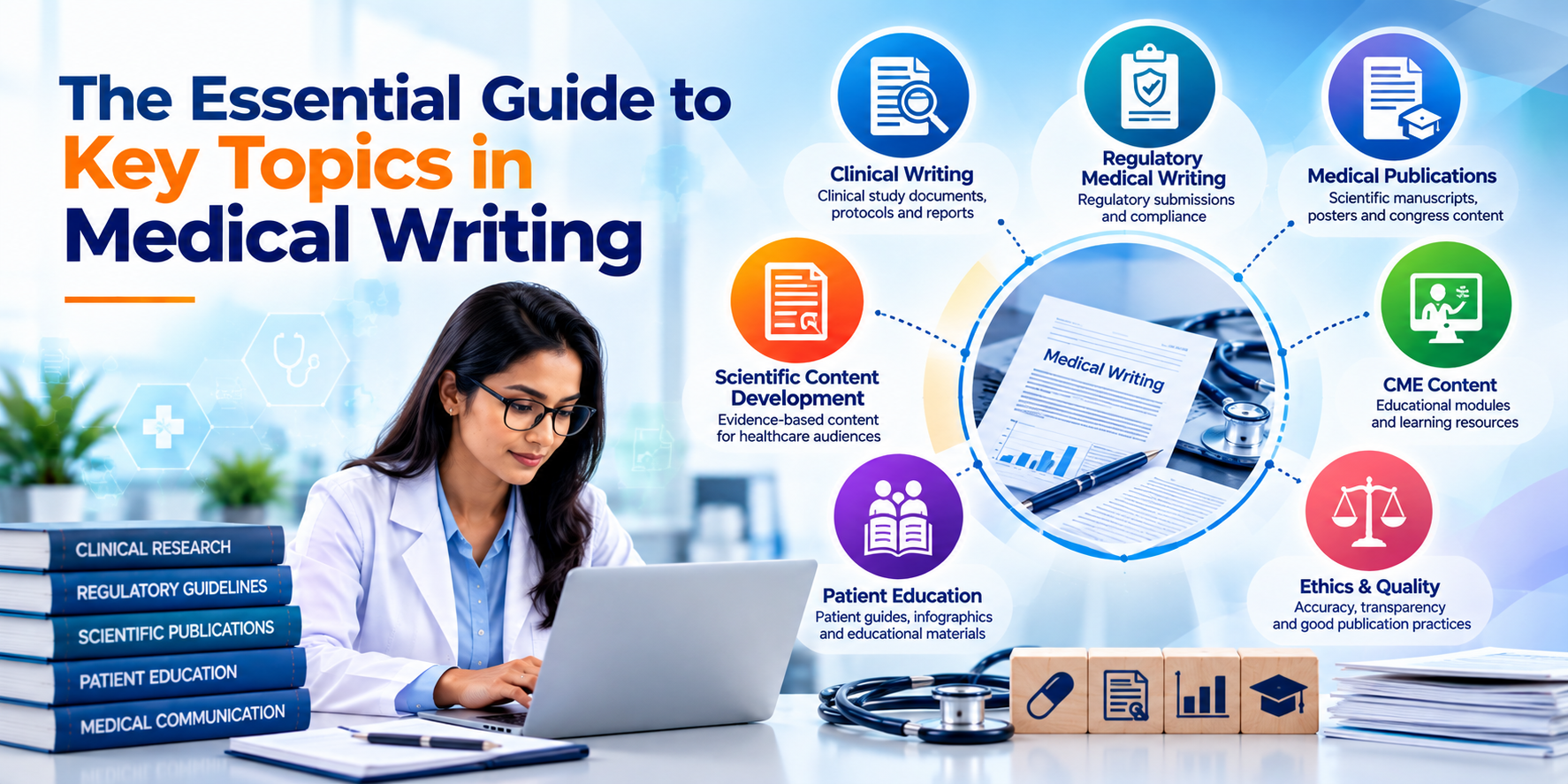
Medical writing supports several areas, including clinical research, regulatory documentation, scientific publications, pharmaceutical communication, and continuing medical education.
1. Clinical Research and Clinical Writing
Clinical writing focuses on documenting clinical research and presenting information about the safety, efficacy, and performance of medical interventions. It supports communication among researchers, sponsors, healthcare professionals, and regulatory stakeholders.
Common clinical documents include:
- Clinical study protocols
- Clinical study reports
- Informed consent documents
- Investigator brochures
- Clinical research summaries
- Patient narratives and study-related documentation
These documents must follow applicable guidelines, approved study protocols, and established documentation standards. Writers also need to understand study design, endpoints, statistical results, and clinical terminology to represent findings accurately.
2. Regulatory Medical Writing
Regulatory medical writing involves preparing documents required for the development, evaluation, and approval of medicines and other regulated healthcare products.
Typical documents include regulatory submission summaries, clinical overviews, safety reports, and responses to regulatory authority questions.
This area requires familiarity with applicable regulatory requirements and guidelines, including relevant International Council for Harmonisation (ICH) guidance. Writers must ensure that information is consistent across documents, supported by evidence, and presented in the required format.
Clear regulatory documentation helps reviewers understand the available evidence and evaluate a product’s benefits and risks.
3. Medical Publications and Scientific Manuscripts
Medical publication writing involves communicating research findings through scientific journals, conference abstracts, posters, and presentations.
A scientific manuscript generally includes an abstract, introduction, methods, results, discussion, and references. Each section serves a specific purpose, from explaining the research question to interpreting the findings.
Important considerations include:
- Accurate representation of research data
- Appropriate citation of scientific literature
- Clear explanations of methods and results
- Disclosure of conflicts of interest and funding
- Compliance with relevant authorship and publication ethics standards
Medical publication support can improve clarity and organisation, but it cannot guarantee journal acceptance. Research integrity, transparent reporting, and appropriate journal selection remain essential.
4. Medical and Scientific Content Development
Scientific content development translates complex medical evidence into information suitable for a particular audience. The format and level of detail depend on whether the intended readers are researchers, healthcare professionals, patients, or the general public.
Common formats include scientific articles, disease-awareness materials, clinical summaries, healthcare website content, and educational resources.
Effective content should use reliable references, explain technical concepts clearly, and distinguish established evidence from emerging findings. Writers should avoid exaggerated claims and make limitations understandable to readers.
5. Patient Education and Healthcare Communication
Patient education content helps people understand medical conditions, treatment options, preventive measures, and instructions provided by healthcare professionals.
Examples include patient information leaflets, medication guides, discharge instructions, frequently asked questions, infographics, and educational videos.
Good patient education uses plain language, short sections, and practical examples. Where appropriate, content should also be adapted for regional languages, different literacy levels, and accessible digital formats.
The goal is to support informed conversations between patients and healthcare professionals rather than replace personalised medical advice.
6. Continuing Medical Education (CME)
Continuing Medical Education helps healthcare professionals maintain and update their knowledge throughout their careers. Medical writing supports CME through educational modules, case studies, scientific presentations, learning assessments, and evidence-based clinical updates.
CME materials should be relevant to professional learning needs, scientifically balanced, and supported by credible evidence. Any applicable accreditation requirements and disclosures should be addressed.
Well-designed educational content can make complex clinical developments easier to understand and apply in professional practice.
7. Medical Writing Ethics and Quality Assurance
Ethics and quality control are essential across every medical writing activity. Content should be accurate, balanced, transparent, and consistent with applicable standards.
A reliable quality-review process may include checking references, verifying numerical data, reviewing medical terminology, confirming consistency across documents, and obtaining appropriate subject-matter expert feedback.
Writers and organisations should also consider authorship criteria, confidentiality, plagiarism prevention, conflicts of interest, and responsible use of artificial intelligence.
AI tools can assist with organisation, language improvement, and initial drafting. However, generated content must be checked carefully because these tools can produce incorrect statements, fabricated references, or misleading interpretations. Qualified human review remains important.
How to Choose the Right Medical Writing Support
Before selecting a medical writing partner, consider the type of document required, the relevant therapeutic expertise, experience with applicable guidelines, quality-control procedures, and data-confidentiality practices.
It is also useful to understand the review process, expected deliverables, revision policy, and responsibilities of authors and subject-matter experts.
The right support should match the scientific complexity of the project and maintain clear boundaries between editing, writing assistance, data interpretation, and authorship.
Conclusion
Medical writing encompasses much more than preparing scientific articles. It includes clinical writing, regulatory documentation, medical publications, scientific content development, patient education, and CME materials.
Each area requires a different combination of scientific knowledge, writing expertise, ethical awareness, and quality control. Understanding these key topics helps healthcare organisations communicate research responsibly, improve the clarity of medical information, and support better-informed professional and patient discussions.
As medical research and digital healthcare communication continue to evolve, accurate and evidence-based medical writing will remain an essential part of the healthcare information ecosystem.
Frequently Asked Questions
What are the main types of medical writing?
The main types include clinical writing, regulatory medical writing, medical publications, scientific content development, patient education, and CME materials.
What skills are important for medical writers?
Medical writers need strong writing skills, scientific literacy, research and reference-checking abilities, attention to detail, and an understanding of publication ethics.
How is clinical writing different from general medical writing?
Clinical writing generally focuses on clinical research and related documentation, while medical writing is a broader field that includes scientific publications, regulatory documents, educational content, and other healthcare communications.
Why is medical writing important in healthcare?
It helps communicate scientific evidence clearly and accurately, supporting research dissemination, regulatory review, healthcare professional education, and patient understanding.